
Let me be honest with you.
There was a time when I’d walk out of the grocery store, look at my receipt, and feel a small wave of panic. $180. Again. For one week. For groceries that somehow disappeared within days, leaving me staring into a half-empty fridge on Thursday wondering what happened.
Sound familiar?
I wasn’t buying fancy steaks or imported cheese. I was buying the usual some produce, snacks, pantry staples, a few frozen things “just in case.” Nothing extravagant. And yet, the numbers kept climbing. In the US, the average family of four spends anywhere between $1,000 to $1,500 a month on groceries. In Canada and parts of Europe, food inflation has pushed costs even higher in recent years. We’re not imagining it. It really is that expensive out there.
But here’s what I discovered: the problem wasn’t what I was buying. It was how I was buying it.
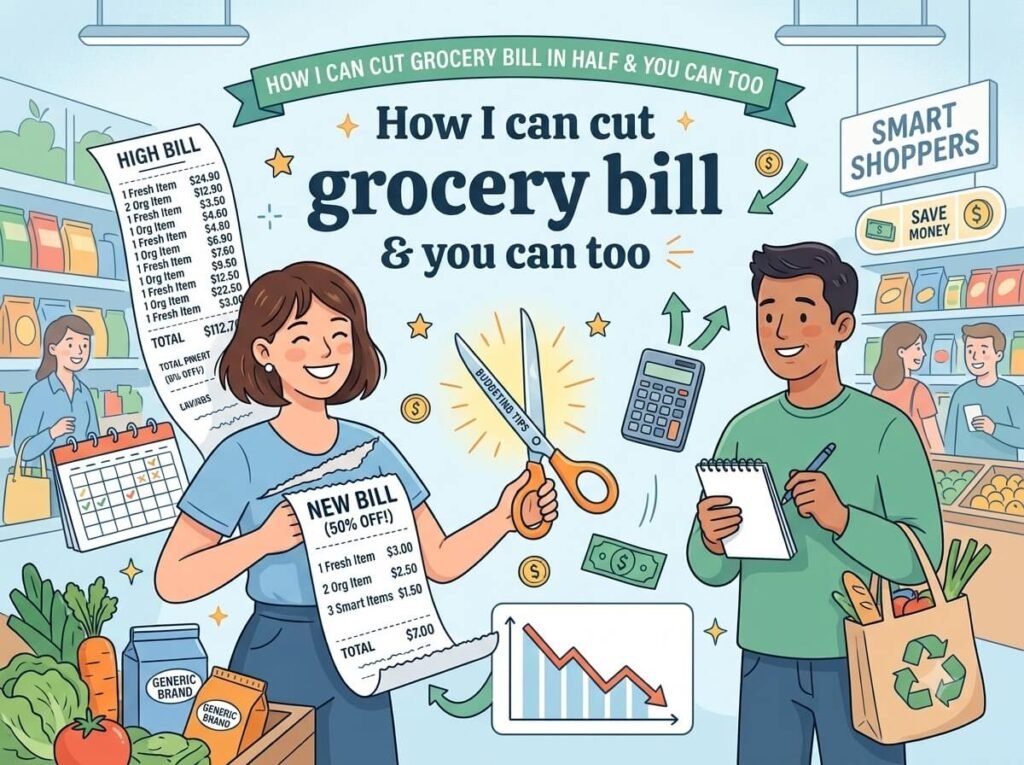
Once I figured that out, I cut my grocery bill almost in half from around $180 a week to under $95 without giving up good food, without eating sad sad salads every night, and without spending my entire Sunday doing meal prep like it’s a part-time job.
I’m going to walk you through exactly what I did. Step by step. Because I genuinely wish someone had told me this sooner.
Step 1: I Stopped Winging It (The Weekly Meal Plan Changed Everything)
I used to grocery shop the same way I used to approach everything when I was overwhelmed — reactively. I’d show up at the store, mentally scan what I thought I needed, throw things in the cart, and hope for the best.
The result? I’d come home, realize I had three types of pasta but no sauce. Or I’d buy a full bunch of cilantro for one recipe and watch the rest rot in my crisper drawer. Sound painfully relatable?
The moment I started meal planning even loosely everything shifted.
Now, before I go anywhere near a store, I spend about 15 minutes on Sunday deciding what we’re eating that week. Breakfast, lunch, dinner. Just the rough outline. Then I write a grocery list from that plan not from memory, not from vibes.
This one habit alone cut my spending by almost 20%. Because suddenly I wasn’t buying things “just in case.” I wasn’t duplicating ingredients. And I wasn’t standing in the store aisle Googling “what can I make with zucchini?” and panic-buying five things I didn’t need.
Here’s a tip that made this even easier: I plan around ingredient overlap. If I’m using chicken thighs on Monday, I make sure Tuesday’s recipe uses the rest of them. If I buy a bag of spinach for a smoothie, it also goes into Wednesday’s pasta. One ingredient, multiple meals. That’s where the real savings start compounding.
Step 2: I Learned to Read the Store Like a Map (Not a Playground)
This one might ruffle some feathers, but grocery stores are not designed for your benefit. They are meticulously designed to make you spend more.
End-cap displays? Those aren’t deals. They’re prime real estate that brands pay extra to occupy. Items at eye level? Usually the most expensive options. The store layout that puts dairy and eggs at the very back? That’s intentional , so you walk past everything else to get to the thing you actually came for.
Once I understood this, I started shopping differently.
I stick to the perimeter of the store as much as possible. That’s where the whole, unprocessed foods live produce, meat, dairy. The center aisles are where the highly packaged, highly marked-up products hide. I go in there with a specific list and blinders on.
I also started buying store-brand (own-brand) products almost exclusively for pantry staples. In the US, store brands from places like Trader Joe’s, ALDI, Costco’s Kirkland line, or even Walmart’s Great Value are often manufactured in the same facilities as name brands. In the UK, Tesco’s own-brand and ALDI’s ranges have beaten name-brand equivalents in blind taste tests repeatedly. The packaging is less flashy. The price is 20–40% lower. The product? Usually identical.
I made a personal rule: I only buy a name-brand product if I’ve genuinely tasted the difference and I genuinely care.
(For me, that’s exactly two things. Everything else? Store brand, no hesitation.)
Step 3: I Got Strategic About Sales Without Becoming a Couponing Fanatic
Let me be clear: I am not suggesting you spend three hours a week clipping coupons and organizing a binder. That is its own full-time job and I respect the people who do it, but it’s not realistic for most of us.
What I am suggesting is a smarter version of this.
Most grocery stores in the US, Canada, and Europe have weekly sales cycles. Proteins – chicken, beef, pork tend to go on sale on a rotation. When I see chicken breasts on sale for a significant discount, I don’t just buy what I need for the week. I buy extra and freeze it.
This is called stocking the pantry strategically, and it’s one of the most underrated money-saving habits there is. You’re not hoarding. You’re buying things you know you’ll use, at the lowest price they’ll be available, so you don’t have to buy them at full price later.
Apps like Flipp (popular in the US and Canada) let you browse store flyers digitally so you can plan your shop around what’s already discounted. In the UK, apps like Trolley.co.uk compare prices across major supermarkets in real time. Using these tools takes maybe 10 minutes but can save you a meaningful chunk every single week.
Step 4: I Fell in Love With Frozen (And Stopped Feeling Guilty About It)
Here’s a food myth I had to unlearn: fresh is always better.
It’s not.
Frozen vegetables are typically picked at peak ripeness and flash-frozen within hours. The “fresh” broccoli sitting in the produce section at your local grocery store? Depending on the supply chain, it might have been harvested a week ago and spent days in transit. By the time it’s in your cart, it may actually have fewer nutrients than its frozen counterpart.
I’m not saying ditch fresh produce entirely. I still buy fresh things I’ll use within a day or two, especially fruit and salad greens. But for cooked vegetables peas, corn, spinach, broccoli, mixed stir-fry bags, edamame . I’ve almost completely switched to frozen.
The savings are significant. A bag of frozen spinach costs a fraction of fresh, lasts for months, and I never have to watch it turn into that sad, slimy thing in the back of my fridge. Frozen berries for smoothies? Same story. A fraction of the cost of fresh, and nutritionally just as good.
This switch alone replacing fresh with frozen for cooked vegetables and smoothie ingredients saves me roughly $20–$30 a month. That’s $240–$360 a year. Not nothing.
Step 5: I Started Cooking in Batches (Without Making It My Entire Weekend)
I used to think batch cooking meant spending all of Sunday in the kitchen making elaborate meals in Tupperware containers while listening to a podcast about productivity. That sounds like a punishment, not a strategy.
What I actually do is much simpler. When I cook, I cook double.
Making pasta? I make twice as much sauce and freeze half. Roasting vegetables? I roast the whole tray, not just what I need tonight. Making a pot of rice? I make a big one and use it for three different meals across the week.
This approach cooking once, eating twice has massively reduced my reliance on takeout and last-minute convenience purchases. Because when I’m tired on a Wednesday and there’s nothing easy to grab, that’s when the app gets opened and I spend $40 on delivery for two people. It’s not laziness. It’s just the path of least resistance when there’s nothing ready.
Removing that friction by having something already cooked and ready saves me far more than any coupon ever could.
Step 6: I Got Honest About What I Actually Waste
This one stings a little.
According to studies in the US and UK, the average household throws away somewhere between $1,500 to $2,000 worth of food every single year. That’s food we bought, didn’t use, and tossed. It’s like throwing cash directly into the bin.
I started paying attention to what was ending up in my trash. Wilted herbs. The last third of a bag of salad. Half a can of something. Leftover cooked grains that I forgot about.
Once I noticed the patterns, I started adjusting:
I buy herbs in smaller quantities, or I buy the tubes of herb paste (basil, cilantro, ginger, garlic) that live in the fridge for months. I store things properly greens go in a container with a paper towel to absorb moisture, and they last twice as long. I do a “use it up” meal at least once a week where I cook based on whatever’s about to go off, not based on a recipe. Some of my best meals have come from these improvised “fridge clean-out” nights.
Every bit of food I stop wasting is money I stop losing. It’s the quietest kind of saving, but it’s real.
Step 7: I Compared Stores And Stopped Being Loyal to the Expensive One
Brand loyalty is a beautiful thing. For grocery stores, it’s often just expensive habit.
I used to go to the same store out of convenience and familiarity. When I actually started comparing prices across different stores in my area including discount grocers, ethnic grocery stores, and wholesale clubs the differences were genuinely shocking.
In the US, stores like ALDI, Lidl, and WinCo consistently undercut mainstream supermarkets by significant margins. In Canada, No Frills and Food Basics are worth the slightly less glamorous experience for the savings on staples. In the UK, ALDI and Lidl have become dominant for good reason. Ethnic grocery stores Indian, Asian, Mexican, Middle Eastern are often dramatically cheaper for produce, spices, legumes, and grains than regular supermarkets.
I’m not suggesting you drive to four stores every week. But splitting your shop buying staples and bulk items at one store, fresh produce at another — can be worth it if the stores are reasonably close.
What My Grocery Routine Looks Like Now
Here’s the honest, unglamorous truth of what I actually do each week:
On Sunday evenings, I spend 15 minutes deciding what we’re eating and making a list. I check one or two store apps to see what’s on sale. I buy a little extra of whatever protein is discounted and freeze it. I shop mostly from the list, mostly around the perimeter, mostly with store brands. I do one “use it up” meal mid-week. And I check my freezer and pantry before I assume I need to buy something.
That’s it. No elaborate system. No binder. No spreadsheet.
The result is that I spend about $90–$100 a week instead of $160–$180. Over a month, that’s nearly $300 in savings. Over a year? That’s close to $3,500 staying in my pocket instead of disappearing into grocery receipts.
Start with Just One Thing
If you’ve read this far, I know you’re ready to make a change but I also know it’s easy to feel overwhelmed by a list this long. So here’s my honest advice:
Don’t try to do all of this at once.
Pick one thing from this list. Just one. Maybe it’s making a grocery list before you shop. Maybe it’s switching to store brands for three items. Maybe it’s buying a bag of frozen spinach instead of fresh.
Start there. See what it feels like. Build from it.
The goal isn’t perfection. The goal is just to be a little more intentional than you were last week and watch how quickly those small, deliberate choices start adding up to something that genuinely changes your financial picture.
You’re not cutting back. You’re just getting smarter.
And trust me your future self, standing at the checkout line with a receipt that finally makes sense, will be very, very glad you started.
Found this helpful? Save it for later and share it with someone who’s been complaining about grocery prices lately — which, let’s be honest, is basically everyone you know.